
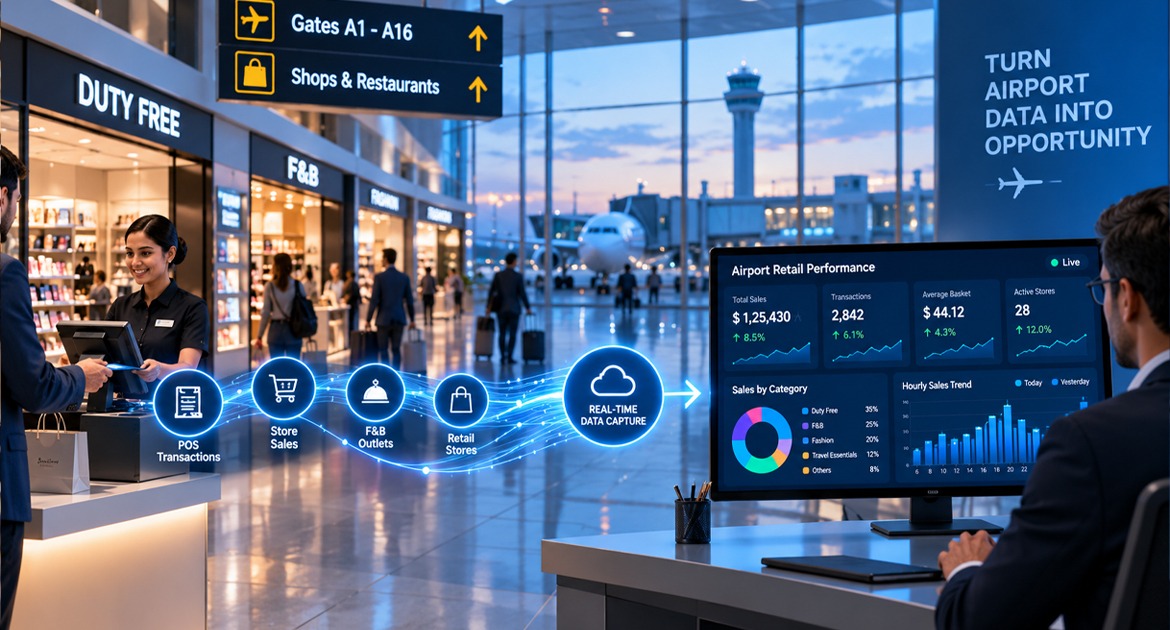
Most airports know their passenger numbers to the hour. Retail sales are a different story. A commercial team asking what the airside duty-free store sold last Tuesday afternoon usually has to wait for a monthly submission, then trust a total it cannot verify. Real-time POS data capture changes that arrangement by giving the airport its own record of each transaction as it happens.
What Is Real-Time POS Data Capture?
Real-time POS data capture is the automated collection of individual retail transactions at the point of sale, transmitted to a central system as they occur rather than compiled and sent later.
The distinction that matters are ownership of the record. Every concessionaire’s POS already records its own sales; that is what a POS does. What airports typically lack is a parallel copy. Under conventional arrangements, the airport receives a summary the tenant has prepared, which means the airport’s view of its own commercial performance is a derivative of someone else’s reporting process.
StoreSense removes that dependency. The airport holds transaction-level data directly: line items, prices, discounts, tax lines, timestamps, and the outlet where the sale happened.
Why Traditional POS Data Reporting Creates Sales Data Gaps
Airports rarely lack retail data. They have data with holes in predictable places, and naming the shape of each hole is more useful than describing the problem in general terms.
Coverage gaps. Generally, larger tenants report reliably. Kiosks, seasonal pop-ups, vending, and temporary trading units frequently sit outside the standard process entirely.
Granularity gaps. A monthly figure per outlet, or per category, cannot answer questions about time of day, basket composition, or which SKUs are actually moving. Most commercial decisions need that detail.
Timing gaps. Data arriving weeks after the trading period describes a situation the team can no longer influence. The promotion has ended; the layout decision is already committed.
Definitional gaps. Two tenants can both report accurately and still not be comparable, because one nets discounts against gross sales, and the other does not, or because their category mappings differ from each other.
Continuity gaps. A terminal that stops transmitting a shift produces a monthly total that still looks plausible. Nothing in an aggregated number reveals the missing hours.
6 Ways Real-Time POS Data Capture Helps Airports
- Sales visibility measured in hours. Trading patterns become visible against the flight schedule: the morning long-haul wave, the afternoon lull, the effect of a gate reassignment on a satellite pier.
- Category and SKU-level insight. Category performance and product-level movement support decisions on retail mix, shelf space, and which brands to prioritize in a tender.
- More defensible billing and reconciliation. Where turnover rent or revenue share applies, an independent transaction record means the invoice is calculated from data both parties can inspect.
- Sales linked to passenger and flight patterns. Combining transaction data with schedule and passenger information shows how spend varies by route profile, time of day, and destination mix.
- Measurable commercial initiatives. A promotion, a signage change, or a new adjacency can be assessed against a real baseline within days rather than argued about at the next quarterly review.
- Better space and lease decisions. Revenue per square meter and sales per passenger, calculated consistently across the estate, give commercial teams a defensible basis for renewals and reconfiguration.
Real-Time POS Data Capture vs. Manual Sales Reporting
| Dimension | Manual sales reporting | Real-time POS data capture |
| Source of the record | Concessionaire’s own submission | Independent capture at the outlet |
| Detail available | Period totals, sometimes by category | Individual transactions and line items |
| Timing | Weeks after the trading period | Real Time |
| Comparability across tenants | Depends on each tenant’s definitions | Normalized to one structure |
| Missing-data visibility | Invisible inside an aggregate | Detectable as a transmission gap |
| Use in decisions | Retrospective reporting | Operational and strategic |
Common Challenges in Capturing POS Data Across Airport Concessionaires
Anyone who has attempted this at scale knows the obstacles are rarely technical alone.
Heterogeneous POS estates. One terminal might run an enterprise platform for duty-free, a cloud system for an F&B group, standalone tills for local retailers, and tablets for a coffee brand. Airports cannot mandate standardization.
Commercial sensitivity. Tenants may view transaction-level transparency as exposure rather than partnership. Offering concessionaires access to the resulting analytics tends to shift that conversation more effectively than contractual pressure alone.
Brand-controlled data. For franchised outlets, sales data may be held by brand headquarters rather than the local operator, which adds a party to every integration discussion.
Airside infrastructure. Network access in retail units is often constrained, and physical access for installation is limited to specific windows.
Data consistency. Multiple currencies, tax treatments, and SKU naming conventions all need resolving before comparison means anything.
Tenant churn. Outlets change hands and refit regularly. If onboarding a new concessionaire requires a project each time, coverage degrades quietly.
What Airport Teams Should Look for in a POS Data Capture Solution
POS-agnostic capture with more than one integration method. You will encounter systems nobody anticipated.
Minimal change to the merchant’s workflow. If store staff must perform an extra step, compliance will drift.
Resilience. Offline buffering, connectivity failover, and clear behavior when a link drops mid-transaction.
Validation and normalization built in. Raw feeds in a dozen formats are an integration project, not a solution.
Integrity of the record. Tamper evidence and an audit trail of what was captured and when.
Monitoring of the capture layer itself. Device status and transmission-gap alerts, since silent failure is the most common way data goes missing.
Role-based access, including tenant-facing views. This supports adoption as much as governance.
A clear position on payment data. Revenue and category analysis needs sale detail, not cardholder data. Confirm what is captured and what is deliberately excluded.
How Real-Time POS Data Capture Supports Airport Retail Analytics
Commercial teams rely on a standard set of retail metrics: sales per passenger, sales per square meter, sales per POS terminal, average transaction value, basket composition, product affinity, and category-level pricing. Each carries a data dependency that a period summary cannot satisfy. Sales per passenger is only actionable when transactions are timestamped finely enough to align with flight and traffic data, rather than a monthly total divided by monthly throughput. Basket composition and product affinity require line items, since a transaction total reveals nothing about what was bought together. Category price comparison requires SKU detail mapped to one category structure across every tenant, and across airports for external benchmarking.
StoreSense, GrayMatter’s airport retail analytics product, is one example of how this is assembled in practice. Its capture layer is a patent-pending device installed between a concessionaire’s existing POS and its receipt printer, so each receipt also streams to the airport with line items, taxes, discounts, and timestamps, without altering the store’s workflow. Where a device is not suitable, integration is supported through REST APIs, flat files, and secure FTP, and an ingestion engine validates and standardizes records before they reach the analytics layer.
Above that sit role-based dashboards for commercial, finance, and marketing teams: drill-down from terminal performance to individual store transactions, product affinity and category analysis, passenger segmentation using flight and purchase data, benchmarking on metrics such as sales per passenger and revenue per square meter, and alerts when a category moves outside its expected range.
Frequently Asked Questions
What is real-time POS data capture?
The automated collection of individual retail transactions at the point of sale, sent to a central system as they happen. It gives an airport a transaction-level record of concessionaire sales independent of tenant reporting.
How is it different from a POS report?
A POS report is produced by the tenant’s system and summarizes a period. StoreSense delivers the underlying transactions continuously, allowing analysis by minute, hour, day, month, and so on, SKU, and market basket analysis rather than monthly sales.
Do concessionaires need to replace their POS systems?
No. StoreSense works alongside existing systems.
What data does the airport actually receive?
Line-item detail, quantities, prices, discounts, tax lines, timestamps, tender type, and outlet identifiers. Cardholder data is not needed for commercial analysis and should be excluded by design.
What happens if a store loses network connectivity?
Well-designed StoreSense stores transactions in a built-in SD card and forwards them once the link is restored. Ask vendors to explain that behavior and how gaps get surfaced.
Can smaller airports use this, or is it only for major hubs?
The approach scales down. What changes is the number of outlets and the complexity of the agreements, not the method.
Conclusion
Sales data gaps in airport retail are structural rather than accidental. They come from receiving summaries instead of transactions, from tenants defining terms differently, and from missing periods that aggregation conceals. Real-time POS data capture addresses the cause, giving the airport a direct and consistent record of what sold and when.
If your team is still reconciling spreadsheets to understand last month’s retail performance, it may be worth seeing what live transaction data from your own terminal looks like.
Explore StoreSense or request a walkthrough built around your concession mix.