
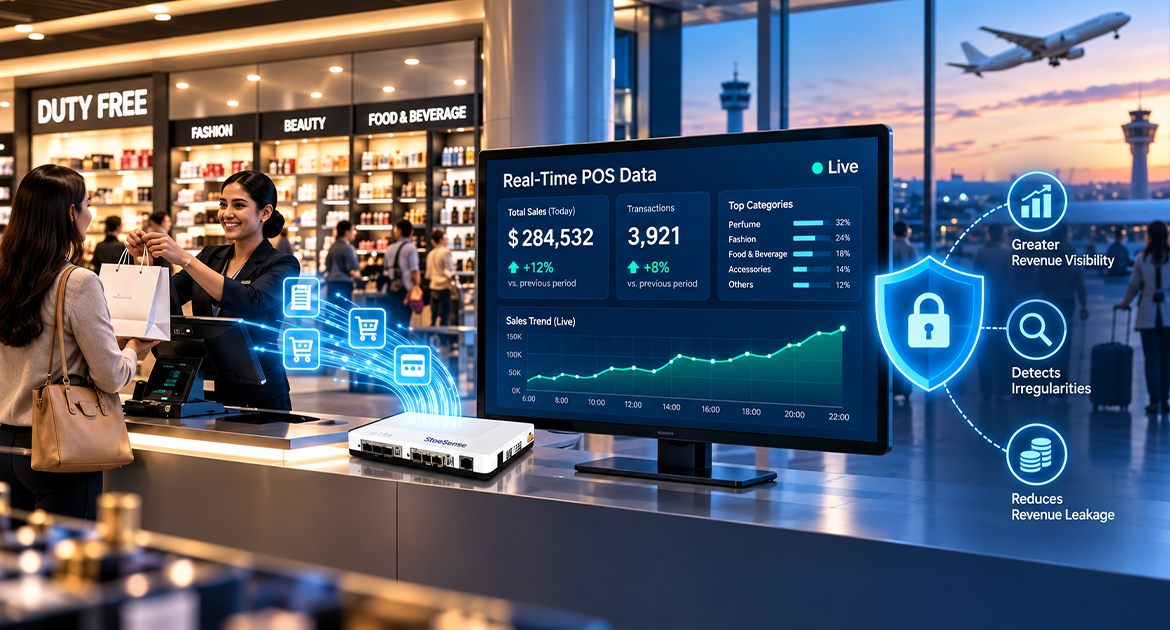
An airport commercial team can tell you exactly how many passengers moved through the terminal yesterday, by hour and by gate. Ask what the duty-free store on the international pier actually sold yesterday, and the answer arrives at the end of next month, in a spreadsheet, from the concessionaire.
Real-time POS data capture closes that gap. Rather than waiting for a tenant to summarize its own performance, the airport holds its own transaction-level record of what sold, when, and at what price. What follows is what revenue leakage looks like in airport retail, why delayed reporting hides it so well, and how commercial and finance teams can build a monitoring process around live transaction data.
What Is Revenue Leakage in Airport Retail?
Revenue leakage is the gap between what an airport is contractually entitled to earn from its commercial estate and what it actually invoices and collects. It rarely arrives as one dramatic event. It accumulates quietly, across dozens of outlets and tens of thousands of transactions a week.
- Under-reported turnover. Concessionaires self-declare monthly sales, and even careful reporting involves judgment about what counts as gross.
- Category misclassification. Revenue-share rates differ by category. Premium spirits booked as general merchandise rather than liquor and tobacco changes what is owed.
- Inconsistent refunds and voids. A void issued after shift close may never reach the figure the airport sees.
- Cut-off differences. An F&B unit trading past midnight for a delayed long-haul departure straddles two reporting days, sometimes two months.
- Discounts and service charges. Whether a promotion reduces the base for turnover rent is a contract question that manual reporting answers inconsistently.
- Threshold effects. Where a lease pairs a minimum annual guarantee with tiered percentage rent, a small error in the sales base can push an outlet across a tier boundary.
- Outlets outside the reporting flow. Pop-ups, seasonal kiosks, and temporary units often never get wired into the standard process.
Most airport revenue leakage is a process problem rather than a fraud problem. Manual submission and inconsistent definitions produce errors in both directions, and without an independent record the airport cannot tell which direction, or by how much.
Why Delayed POS Data Makes Revenue Leakage Difficult to Detect
Traditional revenue reporting has a structural weakness: the party being billed is the only party holding the data used to calculate the bill. Four problems follow.
Data is aggregated before the airport sees it. Aggregation is where anomalies hide. If a store’s POS was offline for six hours on a busy Friday, the monthly total still looks plausible. Those same hours stand out immediately in an hourly series.
Verification is retrospective and sampled. Concession agreements grant audit rights, but audits happen quarterly, cover a sample, and rely on records the tenant produces. Reconciliation becomes a negotiation about the past rather than a check on the present.
Multiple POS estates multiply the work. One terminal might run a duty-free operator on an enterprise platform, an F&B franchise group on a cloud system, three local retailers on standalone tills, and a coffee brand on tablets. Each sends a different format on a different schedule.
Delay destroys the value of the finding. As a hypothetical illustration: a news and gift till stops transmitting after a firmware update on the 3rd. Caught on the 8th, five days of transactions are recovered from local storage. Caught when the statement arrives six weeks later, the outcome is a dispute or a write-off.
How Real-Time POS Data Capture Helps Prevent Revenue Leakage
Data capture does not detect leakage by itself. It is the first link in a chain:
Data capture → data validation → analytics → detection → investigation → corrective action
Data capture gives you a trustworthy record. Validation makes it comparable. Analytics turns it into expected-versus-actual patterns. Detection flags exceptions. Investigation establishes cause. Corrective action recovers the money and fixes the process. Skip a link and you have a well-instrumented terminal with the same disputes as before.
Automated Transaction Capture
Every sale at every outlet is recorded independently of the tenant’s reporting cycle: line items, quantities, prices, discounts, tax lines, timestamps, tender type, store identifier. It does not stop when a store manager forgets to send a file.
Faster Sales Visibility
Teams see performance while it still matters: trading on a heavy morning wave, the effect of a gate change on a satellite pier, the first two days of a promotion. This is where real-time sales data capture earns its keep beyond revenue assurance, and it is usually what gets category managers engaged.
Data Discrepancy Identification
With an independent record, the airport compares its figures against the tenant’s declaration line by line. Discrepancies acquire a shape: a category mapping that differs from the contract schedule, a day where declared sales sit below captured sales, refunds in one record and not the other. Specific discrepancies are resolvable; general suspicion is not.
Revenue Calculation Support
Transaction-level data lets rent and revenue share be computed from the base the contract describes, rather than a summary that already applied someone else’s interpretation. Category rates, service charge exclusions, and turnover tiers get applied the same way every month.
Reduced Manual Reconciliation
Chasing files and rebuilding the same pivot table absorbs a great deal of skilled finance time. Automation does not eliminate reconciliation, but it shifts the work from assembling the data set to reviewing the exceptions inside it.
Anomaly Monitoring
Missing transaction sequences, outlets that go silent during trading hours, unusual concentrations of voids around shift changes, sales per passenger diverging from an outlet’s own history. These surface as alerts rather than year-end audit findings. Monitoring produces questions, not verdicts, and should expect innocent explanations.
Key POS Data Points Airports Should Monitor
Transaction integrity: transaction ID and sequence number, timestamp, store and till identifier, operator ID, transaction status.
Commercial substance: line-item SKU, quantity, unit price, gross line value, discount and reason, tax lines, transaction total, tender type, currency.
Contract classification: category as mapped to the concession agreement schedule, outlet and lease reference, trading period allocation.
Exception signals: refunds referenced to the original transaction, voids and their timing relative to shift close, no-sale events, manual price overrides, negative-value lines.
Operational continuity: device heartbeat, last-transmission time, offline buffering events, tamper alerts. This group is easy to overlook and disproportionately important, since missing data is the most common cause of understated revenue.
Real-Time POS Data Capture vs. Traditional Revenue Reporting
| Dimension | Traditional revenue reporting | Real-time POS data capture |
| Data source | Concessionaire’s own submission | Independent capture at the point of sale |
| Granularity | Monthly or weekly totals by category | Individual transactions and line items |
| Latency | Weeks after period close | Real Time |
| Verifiability | Relies on retrospective audit rights | Airport holds a parallel record |
| Category accuracy | Depends on the tenant’s mapping | Mapped centrally against the contract |
| Refunds and voids | Frequently netted or omitted | Captured with timing and reference |
| Reconciliation effort | Manual collection and re-keying | Automated ingestion; effort shifts to exceptions |
| Detection window | After the fact, sometimes after the lease year | Same day or same week |
| Dispute posture | Negotiation over unverifiable figures | Discussion of a shared data set |
| Billing basis | Declared turnover | Captured turnover, contract rules applied |
How Airport Commercial Teams Can Build a Revenue Leakage Monitoring Process
- Translate the contracts into rules. Document percentages by category, MAG levels, tier thresholds, inclusions and exclusions, reporting deadlines. Airports often find that similar-looking leases treat discounts differently, which is itself a leakage risk.
- Establish an independent feed for every trading location. Partial coverage only tells you about outlets you already trusted. Include kiosks, seasonal units, and anything with an unusual POS setup, because that is where gaps concentrate.
- Validate at ingestion. Field completeness, sequence continuity, permitted category values, tax logic, duplicate detection. Data that fails should be quarantined and visible, not silently dropped.
- Define what normal looks like. Set per-outlet baselines normalized against passenger volumes and flight schedules, so a quiet Tuesday is not read as an anomaly. Then set variance thresholds for declared versus captured sales and for refund and void ratios.
- Build an exception queue with named owners. Every flag needs a person, a response time, and a resolution status. Without ownership, alerts accumulate until nobody opens them.
- Run in parallel before relying on it. Operate captured data alongside declared reporting for a billing cycle or two. Mapping errors, timezone handling, and contract edge cases surface here, and you get a defensible record before taking a finding to a tenant.
- Close the loop. Correct the invoice, then fix the cause: a device configuration, a category mapping, a clause two parties read differently. Recovering one month’s shortfall is useful; preventing recurrence is the return.
What to Look for in a Real-Time POS Data Capture Solution
Coverage across a mixed estate. Airports cannot standardize their tenants’ systems. Look for enterprise, cloud, and standalone POS support through more than one integration method.
Independence from tenant cooperation. A solution relying on the concessionaire configuring an export has reintroduced the original problem at higher cost.
Resilience in real conditions. Ask about offline buffering, connectivity failover, and what happens to transactions recorded while a link is down.
A tamper-evident record. For revenue assurance, the integrity of the record matters as much as its existence.
Validation and normalization, not just collection. Raw feeds in twelve formats are a data engineering project, not a solution.
Contract rule application. Business-rule-driven income computation and a maintained contract repository connect transaction data to an invoice.
Self-monitoring. Device status, transmission gaps, and missing-data alerts.
Low-friction on-boarding. Airports change tenants constantly. If each new outlet needs an IT project, adoption stalls. Hosting model, data protection, and role-based permissions complete the list.
How StoreSense Supports Real-Time Sales Visibility
StoreSense is GrayMatter’s retail revenue assurance product for airports, is built around this problem. Its capture layer is a patent-pending IoT device that sits between a concessionaire’s existing POS and its receipt printer. Every receipt that prints also streams to the airport’s data layer, with line items, taxes, discounts, and timestamps. Nothing changes in the store’s workflow, which removes the main objection tenants raise.
The hardware is designed for terminal conditions: anti-tamper and movement sensors with alerting, battery backup, SD card storage for offline transactions when connectivity drops, LAN, Wi-Fi and 4G/5G options, and remote firmware updates. Data is encrypted in transit and normalized on arrival, and the ingestion engine validates and standardizes input before it reaches the analytics layer, which is what makes cross-tenant comparison meaningful.
Above that sit the parts that turn a stream into decisions. Role-based dashboards cover sales performance by terminal, store, hour and SKU, revenue analytics including MAG versus actual, product affinity, store traffic profiling, and campaign ROI. Contract management and billing maintains a unified contract repository with versioning and business-rule-driven income computation, so invoices come from captured transactions rather than being assembled by hand. For revenue assurance specifically, anomaly and tamper alerts flag missing transactions, voided receipts, and outlier days as they occur.
StoreSense is live at multiple international airports including GAP, BIAL, NIA, MCIA, and many more.
Frequently Asked Questions
What causes revenue leakage in airport retail?
Self-declared turnover that cannot be verified, categories mapped to the wrong revenue-share rate, inconsistent handling of refunds and voids, reporting cut-off mismatches, and outlets that never enter the standard reporting flow. Data gaps from offline POS terminals are a frequent and often unnoticed contributor.
What is real-time POS data capture?
Recording each transaction at the point of sale and transmitting it to a central system as it happens, rather than receiving a periodic summary afterward. For airports, it provides an independent transaction-level record of concessionaire sales.
How does real-time sales data capture work across multiple concessionaires?
Each outlet connects through StoreSense device installed alongside its existing POS or a direct integration such as an API or secure file transfer. Incoming data is validated and standardized into a common structure, letting a duty-free operator, an F&B franchise, and an independent retailer be compared on the same terms.
What POS data should airports monitor for revenue assurance?
Transaction identifiers and timestamps, line-item detail with prices and discounts, tax lines, tender type, contract-mapped category, refunds and voids referenced to the original sale, and the operational health of each capture point. Missing data, rather than incorrect data, is the most common route to understated revenue.
How can airports monitor concessionaire sales without disrupting store operations?
Methods that read transactions passively, without changing the POS workflow or adding a step for staff, avoid operational friction and face far less tenant resistance. Concessionaire-facing dashboards help too, since tenants gain analytics they did not have in exchange for the transparency.
Conclusion
Airport retail leakage persists because commercial data arrives too late, too aggregated, and from the only party with an interest in its interpretation. Real-time POS data capture changes the starting conditions, giving commercial and finance teams an independent transaction-level record and moving the conversation from unverifiable declarations to a shared data set both sides can examine.
That record is the foundation rather than the finished structure. Validation, analytics, anomaly monitoring, and a disciplined investigation process are what convert visibility into recovered revenue.
Want to see how real-time sales visibility could work across your airport’s concession network, from duty-free to F&B? Explore StoreSense or request a 30-minute demo using data from your own terminal.